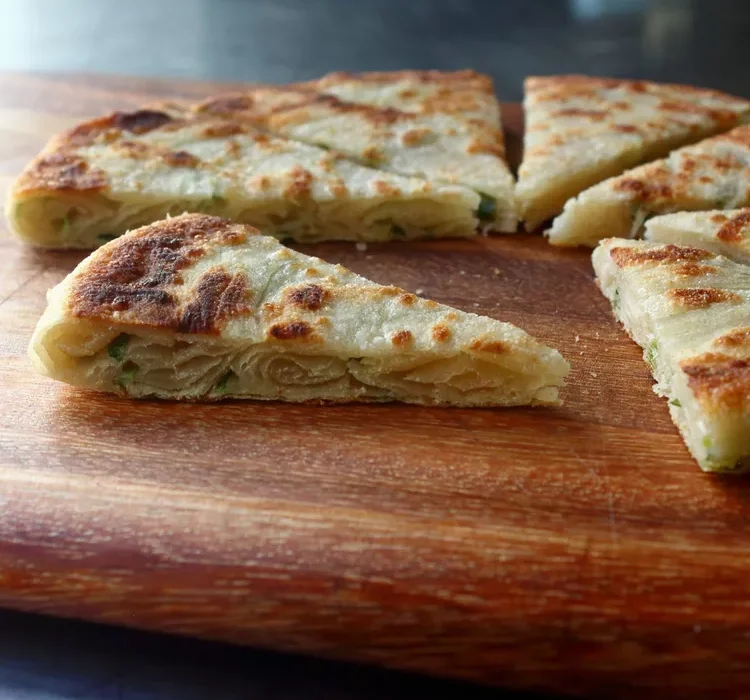
The Ultimate Crispy Chinese Scallion Pancakes (Cong You Bing)
There are few sensations in the culinary world as satisfying as the shatter of a perfectly fried Chinese Scallion Pancake (Cong You Bing). This beloved staple of Dim Sum houses and street food stalls across Shanghai and Taipei is not actually a “pancake” in the Western sense. It is a technical marvel of unleavened dough, laminated with fat and aromatic greens to create dozens of flaky, paper-thin layers.
The secret to a world-class scallion pancake lies in the roux and the folding technique. While many recipes suggest simply sprinkling scallions onto rolled dough, the professional method involves a seasoned flour-and-oil paste that ensures the interior remains tender and distinct while the exterior achieves a golden, bubbly crunch.
In this guide, we will explore the science of hot-water dough, the art of the “coil,” and the precise frying temperatures required to achieve a restaurant-quality result in your own kitchen.
The Components of a Perfect Scallion Pancake
To master this recipe, one must understand the three pillars of its construction:
-
The Hot-Water Dough: By using boiling water, we partially denature the proteins in the flour. This limits gluten development, resulting in a dough that is pliable and soft rather than bread-like and chewy.
-
The Scallion Oil Roux: Mixing toasted flour with hot oil and spices creates a barrier between the layers of dough. This is what creates the “shatter” when you bite into it.
-
The Coil Method: Rolling the dough into a rope and then a spiral traps air and fat, which expands during frying to create those signature concentric circles of flake.
Ingredients
For the Dough
-
3 cups All-purpose flour (plus extra for dusting)
-
1 cup Boiling water
-
1/4 cup Cold water
-
1/2 tsp Kosher salt
For the Scallion Roux (The Laminator)
-
1/2 cup All-purpose flour
-
1/2 cup Neutral oil (Grapeseed, Canola, or Vegetable)
-
1 tsp Toasted sesame oil
-
1 tsp Five-spice powder (optional, for depth)
-
1/2 tsp Kosher salt
For the Filling & Frying
-
2 cups Scallions, very finely minced (white and green parts)
-
1/2 cup Neutral oil (for pan-frying)
For the Dipping Sauce
-
3 tbsp Soy sauce
-
1 tbsp Chinkiang black vinegar (or balsamic vinegar)
-
1 tsp Chili oil or Sambal Oelek
-
1/2 tsp Sugar
-
1/2 tsp Minced ginger
Step-by-Step Instructions
1. Prepare the Hot-Water Dough
Place the 3 cups of flour and salt in a large heat-proof mixing bowl. While stirring constantly with a pair of chopsticks or a wooden spoon, slowly pour in the boiling water. The dough will look shaggy and lumpy. Once the boiling water is incorporated, add the cold water.
Turn the dough onto a lightly floured surface and knead by hand for 5–8 minutes until it is smooth and elastic. Cover with a damp cloth or plastic wrap and let it rest for at least 30 minutes. This rest is non-negotiable; it allows the gluten to relax so the dough doesn’t spring back when rolled.
2. Craft the Scallion Roux
While the dough rests, make the laminating paste. Place 1/2 cup of flour, five-spice powder, and salt in a small heat-proof bowl. In a small saucepan, heat 1/2 cup of neutral oil until it begins to shimmer (roughly 350°F).
Carefully pour the hot oil over the flour mixture. It will sizzle and bubble. Whisk until smooth, then stir in the sesame oil. Set aside to cool to room temperature. It should have the consistency of thick tahini.
3. Shape and Laminate
Divide the rested dough into 6 equal portions. Work with one piece at a time, keeping the others covered.
-
The Roll-Out: Roll a piece of dough into a very thin rectangle (roughly 10×12 inches). The thinner the dough, the more layers you’ll have.
-
The Spread: Apply a thin, even layer of the cooled roux over the entire surface.
-
The Scallions: Sprinkle a generous handful of minced scallions over the roux.
-
The Jelly Roll: Starting from the long edge, roll the dough tightly into a thin cylinder (like a cigar).
-
The Coil: Take the cylinder and twist it gently to elongate it, then roll it into a spiral shape (like a snail shell). Tuck the end underneath.
4. The Second Rest and Final Flattening
Let the coiled “snails” rest for another 15 minutes. This prevents the dough from tearing during the final flattening. After resting, use a rolling pin to gently flatten each coil into a disc about 1/4-inch thick. Don’t worry if a few scallions poke through the surface; these will become crispy in the pan.
5. Frying to Golden Perfection
Heat 2–3 tablespoons of oil in a heavy-bottomed skillet or cast-iron pan over medium-high heat. Once the oil is shimmering, carefully slide in a pancake.
Fry for 2–3 minutes per side. The pancake should be golden brown with charred spots.
Expert Tip: Once the pancake is cooked, use two spatulas (or your hands protected by a clean towel) to “scrunch” or clap the edges of the pancake toward the center. This “fluffs” the internal layers and separates them for maximum flakiness.
Expert Tips & Variations
Professional Secrets
-
Dry Your Scallions: After washing your scallions, ensure they are bone-dry before mincing. Excess moisture will cause the dough to steam rather than fry, resulting in a gummy texture.
-
Temperature Control: If the pan is too hot, the outside will burn before the interior layers are cooked. If it’s too cool, the dough will absorb too much oil and become greasy. Aim for a steady sizzle.
Variations
-
The “Everything” Pancake: Add 1 tablespoon of toasted sesame seeds to the roux for extra crunch.
-
Gluten-Free: While difficult to replicate exactly, a 1:1 gluten-free flour blend with added Xanthan gum can work, though the layers will be less distinct.
-
The Cheat Method: If you are short on time, you can use store-bought puff pastry, though the flavor profile will be significantly more buttery and less traditional.
Serving Suggestions
Scallion pancakes are best served piping hot, immediately out of the pan.
-
Cutting: Use a pizza cutter to slice the pancakes into 6 or 8 wedges.
-
Pairings: Serve as an appetizer for Kung Pao Chicken or Beef with Broccoli. Alternatively, they make a fantastic breakfast when topped with a fried egg and a drizzle of extra chili crisp.
-
Texture Note: The exterior should be brittle and loud when bitten, while the interior should have a soft, slightly chewy “pull.”
Storage & Make-Ahead Notes
-
To Freeze: These pancakes freeze beautifully. Place sheets of parchment paper between un-fried, flattened discs. Wrap tightly in plastic wrap and freeze for up to 3 months. Fry directly from frozen (add 1–2 minutes per side).
-
Refrigeration: Cooked pancakes can be kept in the fridge for 2 days.
-
Reheating: Avoid the microwave, which will make them rubbery. Instead, reheat in a dry skillet over medium heat or in a 400°F oven/air fryer for 3–5 minutes until the crispness returns.
Nutrition Information
Calculated per serving (1 pancake/approx. 1/6 of recipe)
| Nutrient | Amount |
| Calories | 385 kcal |
| Protein | 6g |
| Fat | 22g |
| Saturated Fat | 3g |
| Carbohydrates | 41g |
| Fiber | 2g |
| Sugar | 1g |
| Sodium | 410mg |